
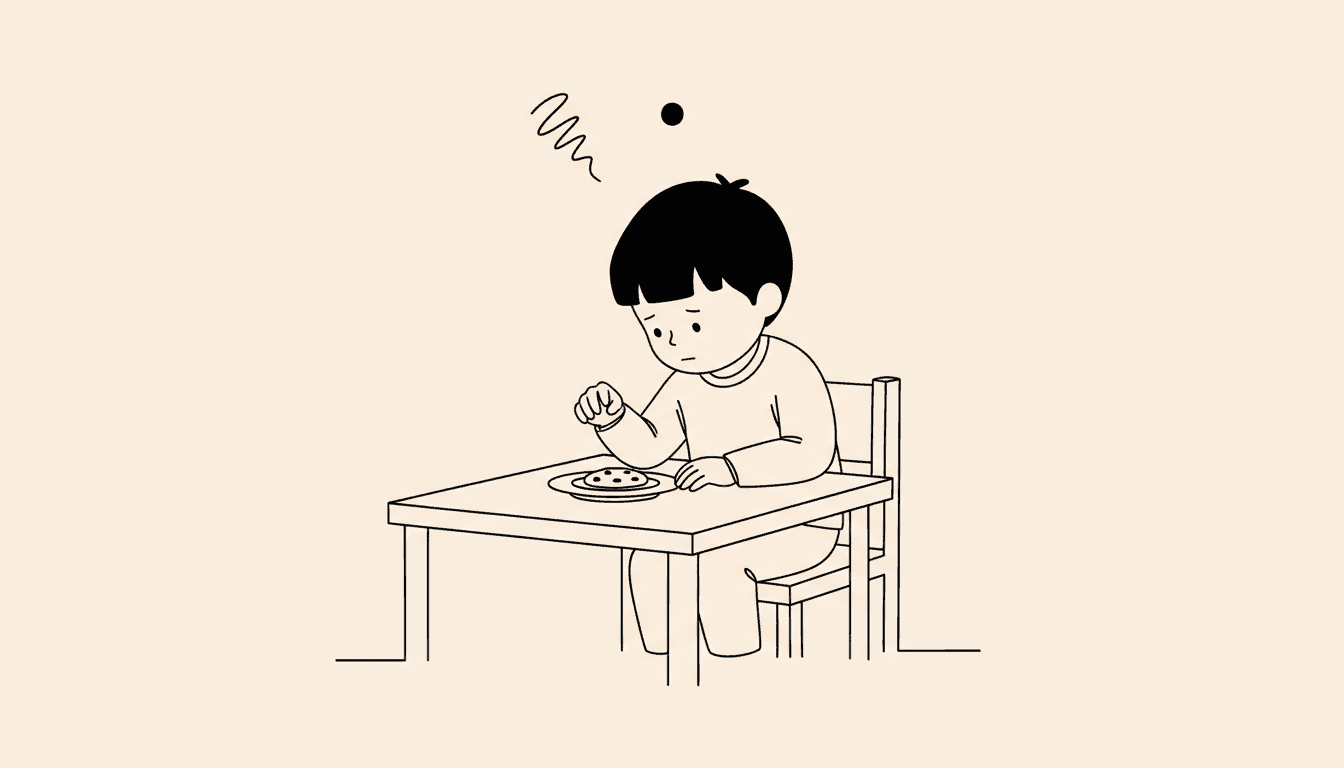
I put one cookie in front of my daughter and told her if she waited until after dinner, she could have two. She looked at that cookie like it owed her money. She lasted about ninety seconds before it was gone, and for a while I filed that away privately as a data point about her character, the kind of thing that was supposed to predict something about who she’d become.
That’s the version of self-control in young children most of us already carry around, even if we’ve never read the original study: a child sits with a marshmallow, told that waiting earns a second one, and how long she waits is supposed to say something lasting about her future. I believed that version for a long time. Then I read what the newer research found, and it changed how I think about a cookie on a plate.
Educational content only. This article is built from CDC, AAP, and peer-reviewed research. It is not medical advice and does not replace your pediatrician’s guidance. If you have concerns about your child’s development, your doctor is the right first conversation, not this article.
Walter Mischel’s original studies at Stanford in the late 1960s and early 1970s tested young children’s ability to delay gratification, and later follow-up work found correlations between how long a child waited and certain outcomes years later. The version of this story that made it into popular culture is short and a little frightening: wait longer as a preschooler, do better in life. That version traveled a lot further than the nuance ever did.
What got lost along the way is that the original samples were small, drawn mostly from families connected to Stanford’s campus community, and the statistical picture was thinner than the popular retelling suggests. None of that makes the original work meaningless. It means the sweeping version of the story, the one where a cookie at age four seals a child’s fate on its own, was never what the data supported in the first place.
I didn’t know any of this the day I set that cookie down. I only knew the version everyone knows, the one that turns into a slightly ominous parenting shorthand: if he can’t wait for the treat, what does that say about him later. That shorthand is exactly what the newer research set out to test directly, instead of assuming it.
Researchers Tyler Watts, Greg Duncan, and Haonan Quan set out to test the marshmallow finding again, this time with a much larger and more economically and racially diverse sample than the original studies used. Their work, published in Psychological Science in 2018, looked at children’s ability to delay gratification around age four and followed up with achievement measures at age fifteen.
They did find a relationship, but a smaller one than I expected going in. An additional minute a child waited at age four predicted a gain of roughly one tenth of a standard deviation in achievement at fifteen, about half the size of what earlier studies had reported. Once the researchers accounted for family background, early cognitive ability, and the home environment, that relationship shrank by about two thirds. Most of what was left came down to a single rough threshold: whether a child could wait at least twenty seconds at all, not how many extra minutes she could hold out beyond that.
Reading that, I had to sit with an uncomfortable question: if delay of gratification itself wasn’t doing most of the work, what was? The honest answer from this research is family background and early environment, the resources and stability surrounding a child well before she ever sees a cookie on a plate. A four-year-old who’s already had more stability, more consistent routines, and more early support has an easier time waiting, and also happens to be more likely to do well later, for reasons that have little to do with the cookie itself.
That reframes what I was watching that day at the kitchen table. My daughter eating the cookie in ninety seconds wasn’t a verdict on her future. It was one small moment, shaped by hunger, timing, mood, and how tired she was that afternoon, sitting inside a much larger set of circumstances that mattered far more than the ninety seconds themselves.
The Watts team still found a real, if smaller, relationship even after every control was applied, and delay of gratification is not meaningless on its own. But a single moment of impatience is a weak signal by itself, one factor among many, not the standalone predictor the popular version of the story made it out to be.
I stopped treating a single moment of impatience as information about who my child is. Self-control at this age is still developing, unevenly and inconsistently, and one cookie says almost nothing on its own. What seems to help, based on Mischel’s own later work with the same children, wasn’t raw willpower at all. Children who waited longest tended to use distraction and reframing, looking away, singing, imagining the treat as something other than food, instead of gritting their teeth against the urge in front of them.
That distinction matters for what I do differently now. Instead of praising or worrying about whether she waits, I try to hand her a strategy in the moment: put it somewhere out of sight, find something else to do with her hands, talk about something unrelated. That’s a skill I can help build. Willpower alone was never something I could hand her.
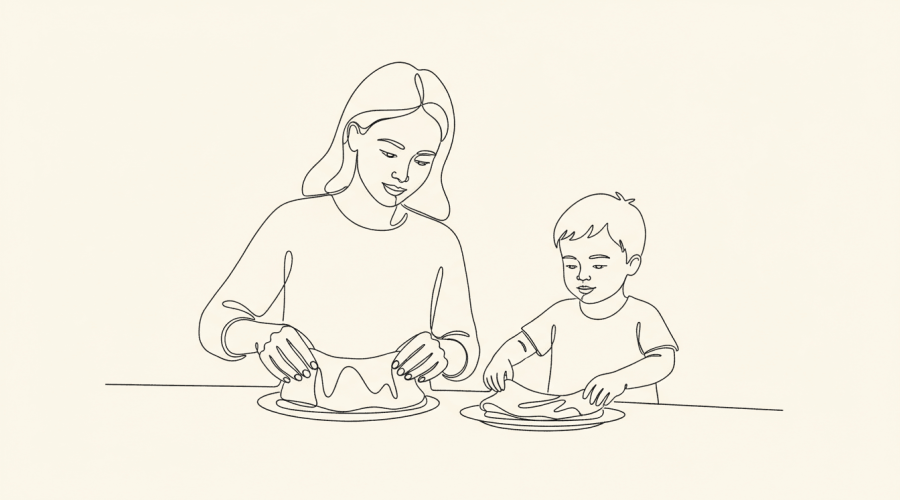
The next time I put a cookie in front of her and asked her to wait, I covered it with a napkin before she’d even had a chance to stare at it, and I asked her to help me set the table instead. She waited the full twenty minutes without once asking about it. I stopped asking her to resist and started giving her something else to do instead. That one shift in approach, not any change in her willpower, made the difference.
The next time I put a cookie in front of her and asked her to wait, I covered it with a napkin before she’d even had a chance to stare at it, and I asked her to help me set the table instead.

Only weakly, according to the best available replication. Watts, Duncan, and Quan (2018), published in Psychological Science, retested the original marshmallow finding with a much larger and more diverse sample than the original studies used. They found a relationship about half the size of what earlier research had reported, and that relationship shrank by roughly two thirds once family background, early cognitive ability, and the home environment were accounted for. Most of what remained came down to whether a child could wait at least twenty seconds at all, not how many additional minutes she could hold out.
Family background and early environment did most of the explanatory work. Children with more stability, more consistent routines, and more early support tended to wait longer and also tended to do better later, for reasons that had little to do with the treat itself. Delay of gratification still showed a real, smaller relationship on its own, but it was one factor among several instead of the standalone predictor the popular version of the story suggests.
Mischel’s own follow-up work with the same children found that distraction and reframing worked better than raw willpower. Children who waited the longest tended to look away, sing, or imagine the treat as something other than food, instead of resisting the urge in front of them directly. This suggests self-control at this age is more of a strategy than a fixed trait.
Not based on a single moment. Self-control in young children between ages three and five develops unevenly, and one instance of impatience says little on its own, particularly given how much of the original marshmallow finding turned out to reflect family circumstances instead of the child’s character. It becomes worth a mention with your pediatrician if a child’s ability to wait or manage frustration seems far behind same-age peers across many settings, not only around food, or appears alongside other concerns involving attention or emotional regulation.
Yes. Instead of asking a child to resist a temptation directly, removing it from sight, giving her something else to focus on, or helping her reframe what she’s waiting for tends to work better than expecting willpower alone. This mirrors what Mischel’s own research found: children who waited longest used strategies, not sheer resistance, which means it’s a skill that can be supported instead of a trait a child either has or doesn’t.
Share this article