
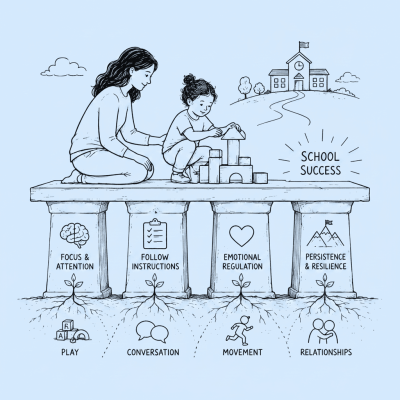
Planning is the skill of looking at a goal and figuring out, in advance, what steps will get you there and in what order. It’s what separates diving in from starting well.
A 3-year-old building a block tower just starts stacking. A 6-year-old looks at the pile first and puts the biggest blocks down before the small ones. That moment of looking before doing is planning in its simplest form.
When impulse management takes enormous effort, there’s very little mental energy left over for learning, problem-solving, and connection. As self-control becomes more effortless, more capacity opens up for everything else a child is trying to do at the same time.
The groundwork for self-control starts in infancy, as a baby begins briefly suppressing a reflex before acting on it. What becomes visible to parents, usually from around age 2 onward, is the steepest, most dramatic part of the climb: a child beginning to manage real impulses, with real effort and real setbacks along the way.
In the earliest years, waiting even a few seconds is genuinely hard, and that’s the starting point every child begins from, not a setback. This skill keeps developing through the school years and well into adolescence. It doesn’t plateau at age 5.
What helps this skill grow is consistent: calm adult responses when the skill breaks down, predictable routines that reduce the total regulation load, and repeated low-stakes moments to practice the pause before it matters.
Before a child can self-regulate, they co-regulate. This is a research term for something parents already know intuitively: when you stay calm in a hard moment, your child’s nervous system borrows that calm. When you escalate, theirs often escalates with you.
This doesn’t mean being perfectly composed every time. It means that your own pause before you respond is, in a very literal sense, the same skill you’re trying to build in your child. You model it every time you take a breath before speaking. Every time you leave the room for a moment instead of reacting. Every time you say “I need a second” before you respond.
Children who grow up around adults who narrate their own regulation (“I’m frustrated right now, so I’m going to take a breath before I say anything”) build the vocabulary and the neural template for self-regulation earlier and more durably than children who receive instruction about it without seeing it practiced.
When the impulse has already fired, explanations and instructions don’t land. What works is physical proximity, a calm tone, and as few words as possible. Your presence, regulated, is the intervention. Let the moment pass before anything else happens.
I’m right here. You’re okay. Let’s take a breath.”
Once your child is calm, briefly name the sequence: “You wanted the toy. You grabbed it before asking. Next time, let’s try asking first.” Short, factual, forward-looking. This is where the skill gets named and reinforced, not in the middle of the storm.
“That was hard. You’re still learning how to wait. So is everyone.”
Find a low-stakes moment to practice what the high-stakes moment asked for. Red light/green light, Simon Says, or simply “wait for it” before a snack: these are deliberate reps for the same skill, without the emotional charge that makes the real moment hard.
Practice is always easier than performance. Build the muscle when it’s not needed yet.
Free Download
Holding instructions and information in mind long enough to use them.
Mapping out the steps before starting something new.
Pausing before acting, even when something feels urgent.
Sticking with something hard until it’s all completed.
Staying with one thing, even with distractions nearby.
Keeping track of your belongings, time, and tasks.