
I used to feel a little guilty on the afternoons my son built an elaborate pretend restaurant out of couch cushions instead of doing one of the structured activity kits I’d bought him. It looked like less than the flashcards or the guided craft. What I have since learned is that self-control in children may develop more from the couch-cushion restaurant than from the kit.
Educational content only. This article is built from CDC, AAP, and peer-reviewed research. It is not medical advice and does not replace your pediatrician’s guidance. If you have concerns about your child’s development, your doctor is the right first conversation, not this article.
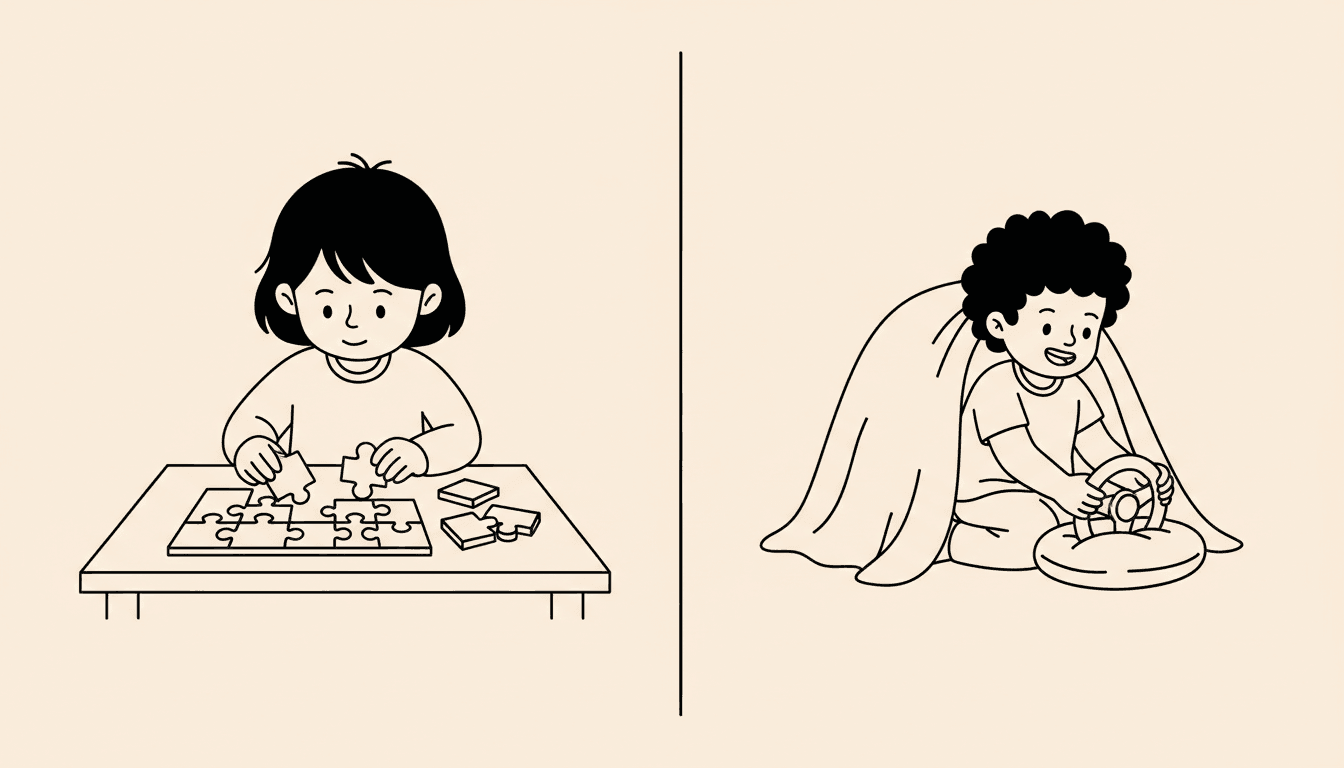
Psychologist Laura Berk, along with colleagues Trisha Mann and Amy Ogan, laid out why in a chapter reviewing this body of research: make-believe play requires a child to set her own goals, invent and hold onto rules for herself, and regulate her own behavior according to a plot she’s inventing as she goes, all without an adult assigning the task or defining what counts as success. A structured activity, by contrast, usually comes with the goal already built in. Follow these steps, get this specific outcome.
That difference matters more than it sounds like it should. Setting your own goal and then holding yourself to a self-invented rule, don’t put the doll to bed until you’ve made the fake dinner first, is a heavier lift for a developing brain than following an adult’s already-defined steps, even though the make-believe version looks like less effortful play from the outside. A worksheet with one correct answer asks a child to comply with an external structure. An invented restaurant asks her to build the structure herself and then obey it, which is a fundamentally more demanding executive task, dressed up as something that looks like idle fun.
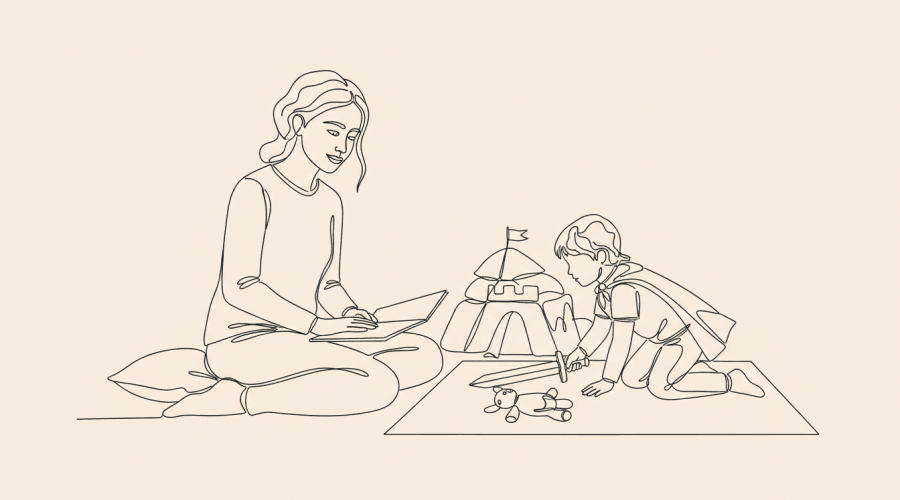
The same researchers found something worth knowing about what reduces this kind of self-directed regulation: heavy adult direction during play lowered the amount of private speech children used, and transitions between activities did too, while playing alongside peers tended to support it. This doesn’t mean adults should disappear from a child’s play entirely. It means the more an adult steps in to direct exactly what happens next, the less room there is for a child to practice setting and following her own rules.
I noticed this myself once I started paying attention. When I hovered over the couch-cushion restaurant, suggesting what the next customer should order, my son’s own narration of the game dropped off noticeably. When I sat nearby without directing it, he kept up a steady stream of self-talk, laying out the rules of his own invented world out loud.
I stopped feeling like the structured activity kits were the more valuable use of time and the pretend play was only filling space before something more productive happened. Based on this research, the reverse may be closer to true, at least for building this specific piece of self-regulation. The kit has value too, but the couch-cushion restaurant is doing real, documented developmental work, not merely keeping him occupied.
That’s changed what I make room for. I protect more unscheduled time for open-ended, self-directed play now, and I try to stay nearby without steering it, which the research suggests supports, not undermines, what’s developing during those afternoons.
For most children, a strong preference for open-ended, imaginative play over structured activities reflects exactly the kind of play this research associates with stronger self-regulation, not a lack of focus, a character flaw, or a failure to engage with “real” learning activities.
What’s worth a mention at a well visit is a different pattern: if a child seems unable to engage in self-directed pretend play at all, even with peers and unstructured time available, or if this shows up alongside other concerns around social engagement or language. Raising a Developmental Concern With Your Pediatrician walks through how to bring an observation like that into a visit in a way that gets taken seriously. Most afternoons, though, a couch-cushion restaurant with an elaborate, self-invented menu is exactly the kind of ordinary play doing more work than it looks like it’s doing.
Research by Kerry Krafft and Laura Berk, published in Early Childhood Research Quarterly in 1998, found that private speech, self-directed talk linked to self-regulation, occurred far more often during open-ended activities, especially make-believe play, than during closed-ended, structured tasks with a single predetermined goal. This suggests open-ended play may support this particular aspect of self-regulation more than structured activities do, at least for this specific measure.
Private speech is the self-directed talk children use to narrate and guide their own actions, in other words, thinking out loud. Research has linked higher rates of private speech to stronger self-regulation and executive function. Studying when private speech occurs most often, as Krafft and Berk did, offers a window into which activities are asking the most of a child’s developing self-regulatory system.
According to Laura Berk and colleagues’ theoretical synthesis of this research, make-believe play requires a child to set her own goals, invent her own rules, and hold herself to those self-created rules without external direction. A structured activity typically comes with the goal and steps already defined by an adult. Generating and following your own rules is argued to be a more demanding self-regulatory exercise than following someone else’s, even though make-believe looks like easier play from the outside.
This research suggests a light touch works best. Krafft and Berk found that heavier adult direction during play was associated with lower rates of children’s private speech, while engagement with peers was associated with higher rates. Being present without steering the plot appears to preserve more of the self-directed, self-regulatory benefit than actively directing the play.
No. A strong preference for open-ended, imaginative play is not a sign of a problem and aligns with the kind of play this research associates with stronger self-regulation. It’s worth raising with your pediatrician only if a child seems unable to engage in self-directed pretend play at all, even with peers and unstructured time available, or if this appears alongside other concerns involving social engagement or language.
Share this article