
I said it once, standing in the kitchen. Get the diaper bag from your room. My daughter repeated it back to me. She turned, walked down the hallway, passed through her bedroom door, and by the time she was standing in the middle of her own room, she was looking around at her toys with no idea why she’d come in.
I used to find this baffling. The instruction wasn’t complicated. It was one thing, not two. It fell apart somewhere between the kitchen and the bedroom, in the walking itself, which turns out to be about working memory and distance: moving from one room to another works against a young child’s memory in a way that standing still doesn’t.
Educational content only. This article is built from CDC, AAP, and peer-reviewed research. It is not medical advice and does not replace your pediatrician’s guidance. If you have concerns about your child’s development, your doctor is the right first conversation, not this article.
There’s a well-documented pattern in memory research generally, sometimes called the doorway effect, that gave me a real explanation for why this particular kind of forgetting felt so specific to the walk itself. Psychologist Gabriel Radvansky and colleagues ran a series of experiments, published in the Quarterly Journal of Experimental Psychology in 2011, in which people carried out brief memory tasks while either walking across a single room or walking through a doorway into a new one, covering the same physical distance either way. People consistently remembered less after passing through a doorway than after covering that same distance without one.
Radvansky’s explanation is that a doorway acts as what researchers call an event boundary. Passing through one seems to prompt the mind to close out and file away whatever was happening in the previous room, the way closing a book chapter makes the last page slightly harder to recall once you’ve turned to a new one. The instruction I gave in the kitchen became, in a small but real way, harder for her to retrieve once she’d physically left the kitchen behind.
It’s worth being precise about what this research does and doesn’t show. Radvansky’s subjects were college students, not young children, so this isn’t a study of five-year-olds specifically. But the underlying mechanism, that changing rooms disrupts memory retrieval in a way that has nothing to do with effort or attention, is a plausible piece of why this pattern shows up so reliably at the doorway and not partway across an open room.
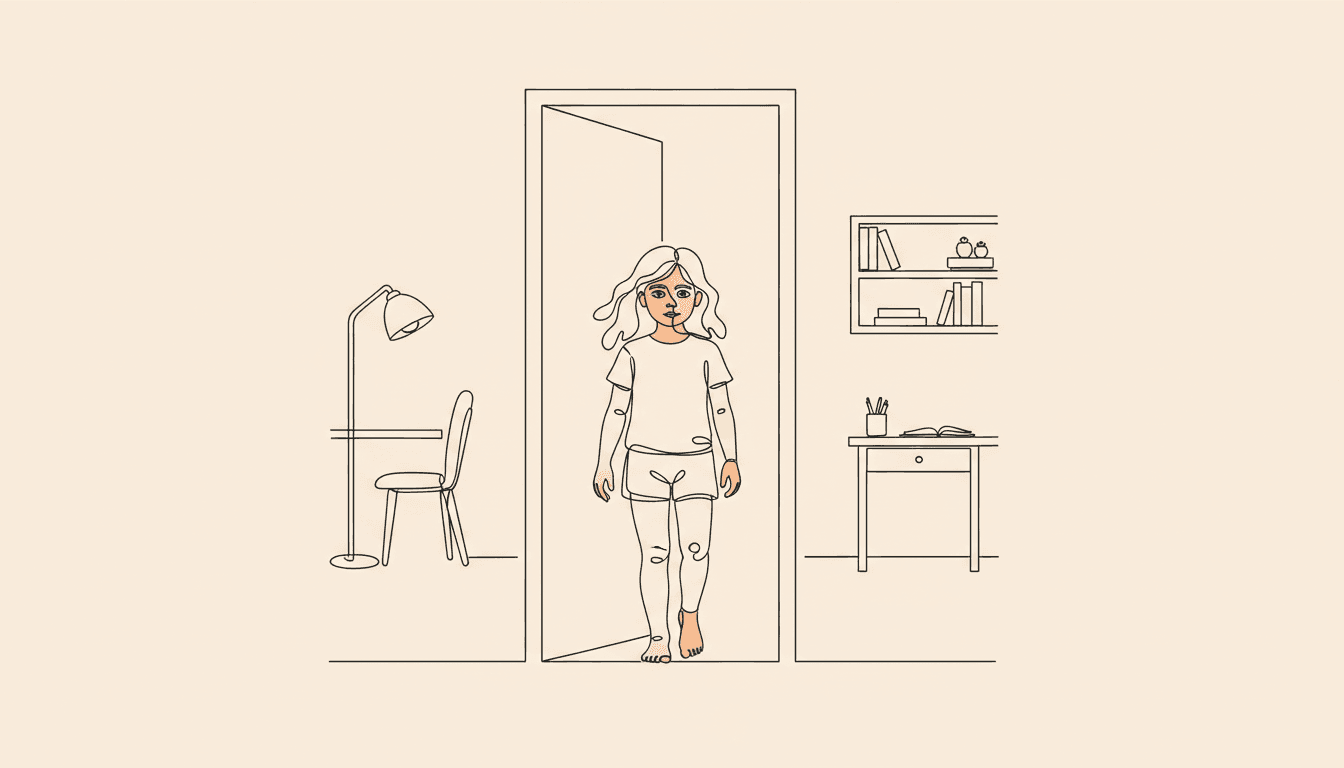
Put the two pieces together and the pattern stops looking mysterious to me. The instruction was held in a workspace with limited capacity to begin with. Then, walking from the kitchen into the bedroom introduced exactly the kind of transition that research on adults shows disrupts memory retrieval on its own. A workspace that was already carrying close to its limit met a transition that research suggests makes retrieval harder for anyone, at any age, and the instruction didn’t survive both at once.
This is why the same child who can hold onto get your shoes while standing at the front door, instruction and action happening in the same room, seems to lose track of that same kind of instruction the moment a bedroom door closes behind her. The room didn’t change what she was capable of. It changed the conditions the instruction had to survive.
This also explains something that puzzled me for a long time: my daughter can complete a longer chain of instructions without a single room change, watering the plants, feeding the fish, putting the watering can back, and yet lose a single one-step instruction the moment a door closes behind her. The length of the instruction was never the deciding factor. The number of rooms it had to cross was.
Once I understood the room change itself as part of the problem, the practical fix wasn’t about repeating the instruction louder or more slowly. It was about reducing the number of transitions an instruction has to survive before it turns into action.
Walking partway with her for the first few instructions of the day keeps us both in the same event, instead of sending her into a new room to hold an instruction alone across a boundary that tends to work against her. Saying the instruction again, briefly, right at the doorway she’s about to cross, resets the workspace at the exact point where it’s most likely to lose what it’s holding. And for anything that can’t wait for the walk, handing her a physical object tied to the task, the diaper bag itself instead of the words describing it, gives the instruction something to travel with her that a doorway can’t file away the same way words can.
Here’s what this looks like in my house now: instead of Go get the diaper bag from your room, said once from the kitchen, I walk her to the doorway of her room and say it again there, right before she crosses through. Or better, I walk in with her the first few times so the instruction and the action happen inside the same event instead of two. Neither version asks more of her attention. Both shorten the distance the instruction has to survive.
This means recognizing that a room change is a small cost to an instruction’s chances of surviving, and building that cost into how I ask, while still sending her to another room whenever it’s needed.
Two separate factors combine at the moment a child crosses from one room to another. First, working memory in children this age has a limited capacity, confirmed by research from Pailian and colleagues (2016) and earlier work by Simmering (2012). Second, research on adults by Radvansky and colleagues (2011) has documented a doorway effect, in which crossing a room boundary disrupts memory retrieval as its own distinct mechanism, separate from attention or effort. An already-limited workspace meeting a transition research shows works against memory in general explains why the same instruction that survives inside one room often does not survive the walk to another.
Not directly. The doorway effect research, led by Gabriel Radvansky, was conducted with college-age adults, not children. What can be said accurately is that the underlying mechanism, that changing physical location disrupts memory retrieval independent of effort or attention, is well documented in the general memory research literature and offers a plausible explanation for a pattern many parents observe consistently in young children.
No. It means recognizing that a room change adds a small, real cost to an instruction’s chances of surviving, and adjusting accordingly instead of avoiding transitions altogether. Repeating the instruction at the doorway, walking partway with the child, or handing over a physical object tied to the task all reduce that cost without limiting a child’s independence.
Working memory capacity increases gradually through early and middle childhood, according to Pailian and colleagues (2016), approaching adult-like levels somewhere between ages six and eight. As the underlying capacity grows, an instruction has more room to survive a transition even without any adjustment to how it is given, which is why this specific pattern of forgetting tends to ease with age on its own.
This pattern, on its own, is not typically a concern at this age. It is worth raising if instructions are consistently lost even within the same room, without any transition involved, or if it appears alongside other concerns involving attention, language, or following directions more broadly. Your pediatrician can weigh the full pattern against your child’s overall development.
Share this article