
Task persistence: it's not encouragement that builds this skill

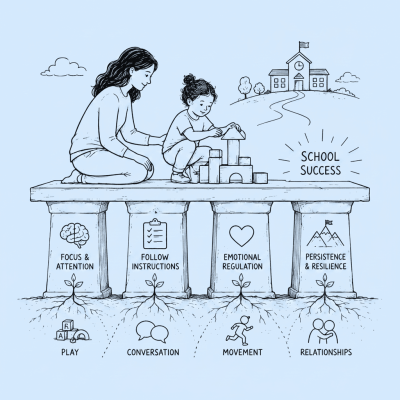
The most common advice about persistence, praise effort and keep encouraging, is well-intentioned. Research shows something more specific builds it. The right level of difficulty matters more than the support around it.
school-readiness
What it is

Staying in the hard part, instead of leaving it

Task persistence is the skill of continuing with a task that is genuinely difficult, through the frustrating middle section, until it reaches completion. It’s not about working on something easy or enjoyable. It’s specifically what happens when something gets hard and a child keeps going anyway.A puzzle that’s slightly too difficult. A shoelace that won’t tie on the fourth attempt. A drawing that isn’t coming out right. The moment between “this isn’t working” and “I’m going to try again” is where persistence lives.
The key variable

The difficulty zone that builds the skill

Persistence only grows in one of three zones. The other two, too easy or too hard, both produce zero persistence, for opposite reasons.
Too easy

No frustration, no practice

A task your child can already do comfortably. They complete it without effort, which means they practice completing things but not the skill of pushing through something genuinely hard.

Result: completion, no persistence built

Just right

Hard but genuinely finishable

The task should make your child work, feel frustrated, and want to stop at least once, but be completable with sustained effort. This is the only zone where persistence is built.

Result: real persistence, skill growth
Too hard

No path to completion

A task so far beyond current ability that no amount of effort will succeed. Repeated failure here builds learned helplessness rather than persistence.

Result: avoidance, nothing built
Free Resources
Why it matters

25

years later

“Attention span and task persistence at age 4 significantly predicted the likelihood of completing college at age 25, independent of math and reading skills measured at the same age.”

How to build it

What helps, and what doesn't

The most commonly given advice about persistence is only partly right. Here's what the research distinguishes.
What builds it
What doesn't build it
How it grows
Gradual, shaped by experience, not fixed by temperament

he earliest signs of persistence show up in toddlerhood, in a child’s willingness to keep trying a simple physical task after it fails the first time. What develops over the preschool and early school years is the ability to stay with tasks that are mentally, not just physically, frustrating.

Children aren’t born with this skill already built. They’re born with the capacity to build it, and that capacity is unusually responsive to the quality of the challenge they’re given. Research shows this skill varies more by environment than almost any other executive function skill. It grows in the right conditions and can stagnate in the wrong ones.

What those right conditions share: a genuine challenge, a calm adult nearby who doesn’t rescue immediately, and enough repetitions of “I was frustrated and I got through it” to make that experience feel normal rather than alarming.

Resources

Build this skill, starting today

Free Download

The task persistence activity guide

A complete printable guide for building this skill, at any age.
school-readiness
Go deeper

Read the research

Looking for more activities like the ones above?

Learn + Play has a full, age-sorted library of switching games, rule-change activities, and printables built specifically for cognitive flexibility. New activities are added regularly.
Keep building

The other skills that matter most

Executive function is made up of seven core skills. Here are the other six.

Working memory

Holding instructions and information in mind long enough to use them.

Planning

Mapping out the steps before starting something new.

Self-control

Pausing before acting, even when something feels urgent.

Task persistence

Sticking with something hard until it’s all completed.

Attention and focus

Staying with one thing, even with distractions nearby.

Organization

Keeping track of your belongings, time, and tasks.

Free Resources